Author: Kristin Corey
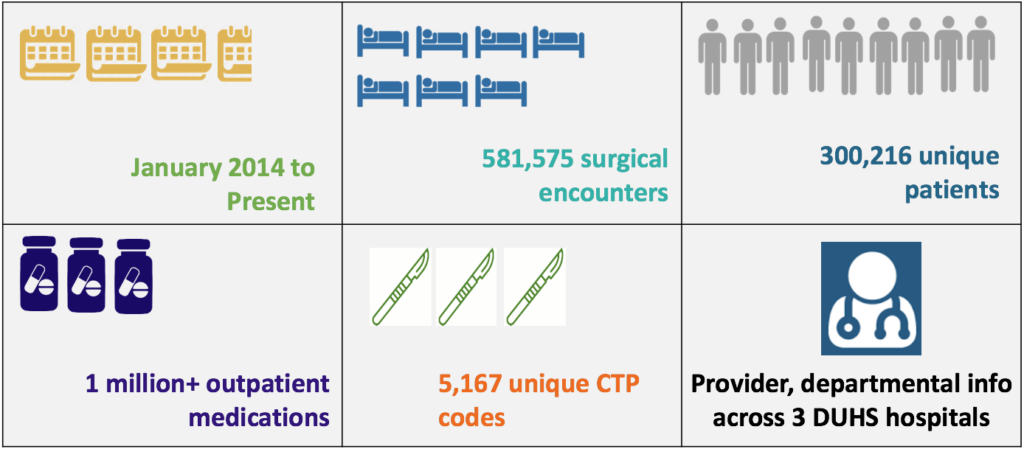
Insights from Aggregated Surgical DataPythia sprouted from a surgical data science projection surgical outcomes. Specifically, the project began as a post-operative patient outcome predictor for high-risk geriatric patients. However, given the creative freedom to explore endless possibilities with coding and access to data, my colleague, Sehj Kashyap, and I found ourselves saying “let’s see if we can go bigger”. And so we went bigger. With mentored guidance from Mark Sendak, MD and Suresh Balu, in six months we were able to complete an initial version of a surgical data mart, housing over 145,000 invasive surgeries on over 90,000 patients since 2013. The features of our data repository include curated clinical features, such as comorbidities, complications, CPT codes, outpatient medications, demographics, as well as inpatient encounter information, such as length of stay and mortality. Given the data science medium and the concurrent work of our colleagues at DIHI (see “DELPHI”), we decided to name this resource “Pythia”. Working with Liz Lorenzi, a Ph.D. student in the Department of Statistical Sciences, we created a machine learning model that predicted the risk of post-operative complications not only for geriatric patients but for all of Duke’s surgical patients. We then embedded the model in an online risk calculator for easy clinical interpretability and usability from a healthcare provider standpoint. Our team submitted the work for publication and were honored to present at the annual Machine Learning in Healthcare Conference at Stanford University in August.
Scaling Up
However, our team’s journey was far from over. After just one year “let’s see if we can go bigger” was said yet again and over the summer we were able to re-write Pythia’s source code. Our data repository now incorporates all procedures at DUHS (medical and surgical) from all three hospitals. There are almost a million procedures, making up over 614,000 surgeries on more than 311,000 patients since May 2013. With the primary aim to create an open science research platform to enhance our DukeHealth community research and innovation, our team’s work has been significantly recognized. We are now fully supported by the Department of Surgery, with the Alan Kirk, the department’s chairman, as our PI. With a whole new year ahead of us, who knows where we’ll be in twelve months.