
Volume 26
Over the past year, changing policies and trends have reshaped our health care innovation strategy. As health systems everywhere have continued to face workforce shortages, financial challenges and shifting regulatory patterns, so too have they benefitted from the unprecedented opportunities afforded by responsible use of GenAI, and leaps in the integration of digital technologies to better meet patient needs. Amid these dynamic changes, Duke Health continues to prioritize innovation across the entire system keeping both patients and care teams at the center and staying true to its mission. This annual report outlines key solutions our team implemented, including an initiative that improves integration of health-related social needs into electronic health records (EHRs). By leveraging large language models, we make it easier for care teams to access and organize information about social drivers, enabling them to quickly connect patients with community resources. Download Impact Report Vol 26
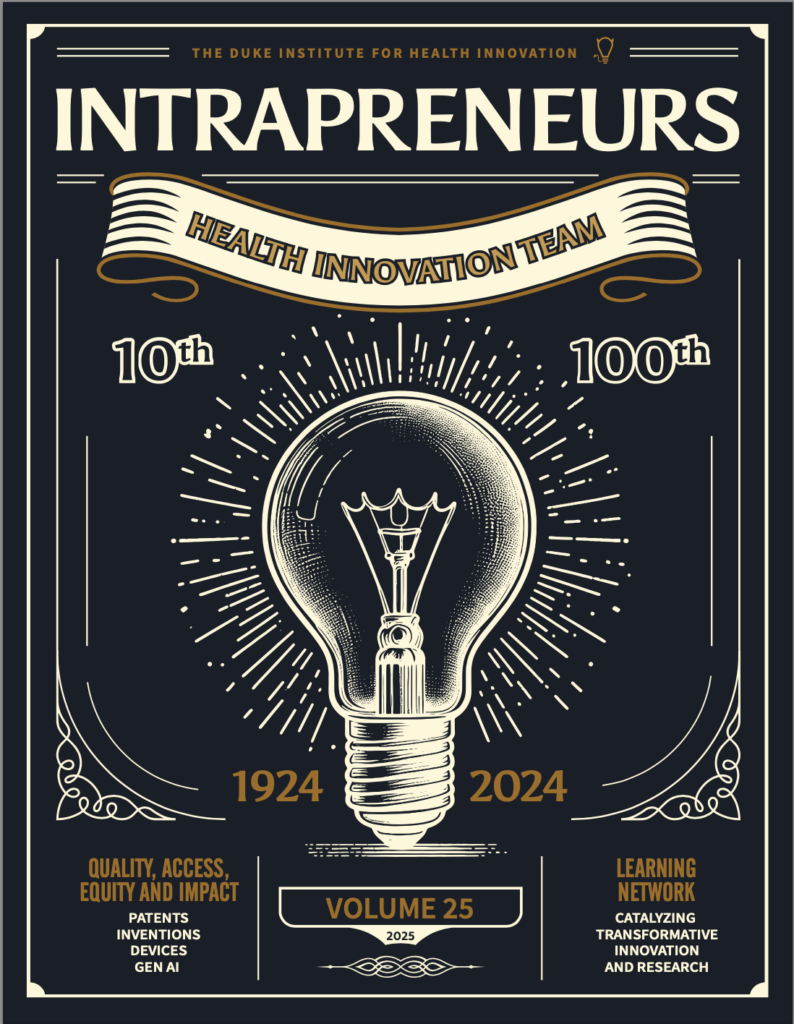
Volume 25
This year marks a special milestone as we celebrate our 10th Anniversary and Duke University’s centennial. This volume’s artwork was inspired by 1890-1920 medical almanacs and the hand-drawn designs of that era’s innovators, symbolizing our commitment to building on Duke’s rich 100-year legacy while embracing modern technologies and innovative solutions. Trinity College became Duke University during a transformative era marked by significant advancements in automation, communication technology, and creative arts. This pioneering spirit resonates with DIHI’s mission to tackle complex healthcare challenges. Our dedication to enhancing healthcare quality, access, equity, and value reflects the progressive ideals of the 1920s, such as the expansion of women’s voting rights and the establishment of public health resources in schools. Our focus on workflow improvements and impact measurement mirrors the industrialization ideals that defined the era. Just as the 1920s brought about breakthroughs in radio, automobiles, and household appliances, we are now witnessing exciting advancements in generative AI and large language models. These innovations inspire us to envision a future where work is less burdensome and more fulfilling. We reflect on a time when social interactions were primarily face-to-face, fostering tight-knit communities, and we yearn for unstructured time filled with imagination and creativity—where information overload and multitasking are minimized. With “Eruditio et Religio” (Duke’s original motto), we can pave the way for a healthier, more rewarding life. Download Impact Report Vol 25 Listen to Impact Report, Vol 25

Volume 24
This year, our innovation efforts focused on automation
to enhance healthcare operational efficiency. This report
highlights some projects our leadership selected to align with
the above themes through the annual DIHI call for proposals,
a competitive process for developing, implementing, and
scaling interventions across the clinical enterprise. Outside
the DIHI RFA process, our team led efforts to establish the
Health AI Partnership in collaboration with local, regional,
and national peer institutions, community partners,
professional societies, and regulatory bodies. Funded by
the Gordon Betty Moore and McGovern Foundations, the
partnership seeks to empower healthcare organizations to
use AI safely, effectively, and equitably while being a trusted
resource for healthcare professionals vested in leveraging
innovation and technology for a human-centric approach
to providing care. And we have continued to engage with
learners – from local schools in Durham to undergraduate
and professional students at Duke, medical fellows, and
residents. We also describe their contributions to advancing
innovation in this edition of the DIHI Impact Report.
Download Impact Report, Vol 24

Volume 23
In a year filled with challenges, our exceptional faculty, staff, and learners found powerful opportunities to collaborate, innovate, translate data science to health benefit and accelerate solution deployment for real-world issues facing our patients and care teams.
In the weeks and months when we could have hunkered down and paused work on untested processes
and solutions, we instead chose to push ahead and expand the scope of what was possible. Not only did we adapt to the constraints placed by the pandemic and other circumstances, but Duke Health also led
the way in fostering an ecosystem that made ideation and implementation of innovative solutions more mainstream. Earlier this year, we hosted the annual Machine Learning for Healthcare Conference, where we had an opportunity to showcase our implementation success stories on the one hand, but also share with our peer institutions and learn from them about best practices for implementing innovative machine learning models for greatest impact.
Download Impact Report, Vol 23
Issue 22
Despite the obvious challenges of the past year, there were also many opportunities for us to advance and scale innovation in patient care - from enrollment of the first Duke patient to receive hospital-level care in the comfort of
her own home, to using augmented reality in epileptic surgery to expanding the scope of two highly successful and responsive AI/ML models to predict adult sepsis and decompensation, to benefit our pediatric patients. None of these would have been possible without the remarkable talent and dedication of our frontline clinicians, staff, students and trainees.
One of our principal areas of growth and success this past year has been in integrating AI and machine learning (ML) to inform patient care. Our faculty and staff are in the forefront of developing best practices for safe, effective and responsible use of AI in healthcare delivery settings. Models developed and implemented through DIHI have helped clinical decision-making for improved safety and quality while helping to alleviate clinician workload and understand underlying biases that may ultimately impact outcomes in diverse patient populations.
Download Impact Report, Issue 22
Issue 21
As 2020 draws to a close, we cannot help but reflect on the months past and how the ongoing pandemics of COVID-19 and racism have affected all aspects of life. Our people – faculty, staff and students – have met this moment with courage, tenacity, resilience and nothing short of heroism. We are grateful to the many clinicians, frontline staff, administrators, educators, researchers and learners at Duke Health who, despite the trying circumstances, have forged ahead in our mission of advancing health together. In supporting that mission, our innovation projects this year have focused on the following broad thematic areas: preventing healthcare-acquired infections and enhancing quality and safety; enhancing transitions of care; team-based and new care models; building resilience and wellbeing; and population health and analytics. Download Impact Report, Issue 21

Issue 20
As health care systems face increasing costs and reimbursement uncertainty, value-based models of care and population health management have gained significance. To reflect these realities, the portfolio for the Duke Institute for Health Innovation (DIHI) has continued to evolve to meet these challenges and address the needs of our patients. In this past year, we have focused our efforts in quality and patient safety, preventing hospital acquired infections, team-based care models, novel patient interactions and population health. Download Impact Report, Issue 20
Issue 19
Over the past year, we have expanded our capabilities within data science, focused on the implementation of machine learning models, and continued to engage 3rd year medical students and trainees in research and innovation activities. Our data science team has undertaken the work of automating the ingestion of raw Medicare claims by cleaning and normalizing ACO claims data. This is a first for Duke and we believe that through this new capability, we can leverage not only clinical data to make better predictions but also claims data. We have used this capability to predict the need for palliative care consultations as well as to predict first admission to the hospital. Download Impact Report, Issue 19

Issue 18
The Duke Institute for Health Innovation (DIHI) was established in 2013 as a platform to advance health and health care innovation at Duke Health and catalyze innovation in the clinical enterprise. Fiscal year 2017 was marked by a significant expansion in the breadth and scope of projects that were aligned more closely with the mission and goals of Duke Health as articulated in Advancing Health Together. Download Impact Report, Issue 18